|
 |
|
INTERVIEWS OF TWO SYRIAN ARMENIAN GIRLS
13 September 2011, Damascus
We are driving through Aleppo's chaotic traffic in Carine’s (name changed) Honda Accord. The 21-year-old girl is studying fashion design. She belongs to the Armenian minority of Syria, they are 50 thousand in the city and 100 thousand in the country. According to her, the current regime protects the minorities, including hers: the Armenians have their culture, their language, their school and their church.
Carine lives in a bourgeois ghetto. She doesn’t have any Muslim friends, she spends her time with other Armenians. She tells that even in the University she finds it impossible to communicate with the Muslim fellow students. She could never imagine marrying other than an Armenian man – who else could dance to their traditional songs with here, she asks. Carine is afraid of any change in the country. She thinks that things can get only worse and doesn’t understand why somebody wants a revolution now when the past ten years, since Assad Jr. is in power, the country has been developing fast to better direction, especially in the economy. If there were free elections, Carine would vote the ruling Baath Party and president Assad. I ask about poverty, could that be to some people a reason to rebel. Carine says that in Syria everybody has enough to eat, you can find a falafel sandwich for 10 SYP (15 Euro cents). It's true that I have seen only one beggar during the first week in Syria. I’m lounging in a restaurant with Anahid (name changed) drinking arak, a typical Syrian anise flavored alcoholic drink, and smoking nargile, waterpipe. Anahid is 25 and finished her fine art degree last year in Aleppo where she still lives though she is originally from Homs, which is one of the epicenters of fighting between the military and rebels. All her family lives in Homs and they are trying to get out but it seems to be impossible, too dangerous. She shares a flat, which serves also as a painting studio, with other young artists in Aleppo. Her friends represent all religious and ethnic groups of the country. In Homs the Armenian community is small, she had to relate with people from all other communities. She says that actually she doesn’t like Armenians and their ghetto in Aleppo. Anahid is hoping that everything will change in the country. First, she demands civil rights and free elections, though she doesn't know what party she would vote. Anahid asks if I need any eau de toilette, she can get good discounts on them because she earns money now by working in the make-up business, though she is dreaming to be able to work full-time artist and to do a master degree in Europe, maybe in Germany.
DANCING IN A CONFLICT ZONE
11 September 2011, Damascus
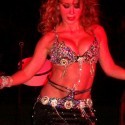
My workshop was a success. The participants were two clearly different groups: bourgeois Christian art students and art lovers and Palestinian youngsters from a refugee camp. I told them about my list works and showed a selection of lists in works of contemporary art. Then they produced an awesome set of lists including: My Favorite Cartoon, Important Camps for Palestinians, Food for Poor People, My Favorite Thing I like but I Can’t to Buy It or Do It, The Name of People I Love but I Can’t See Him, Reforms I Want It to Be in My Country, Names of People Who I Losted in My Life, What I Hate in Men and The Perfumes that I Love [all sic]. In the afternoon, I walked in the Public Park and realized that somebody was following me. I sat down, he sat down. I got up, he got up. I turned, he turned. I sat down again, he sat down again. Later in the hotel lobby another guy came to talk to me joyfully and informed me that he had seen me at the Aleppo airport the other day. Am I monitored or is it just my imagination because I want so badly to be important and dangerous? Issa had invited some friends to his place to have dinner. It was good to talk with many people in a relaxed atmosphere. We were sitting at the terrace, eating Syrian pizza, drinking Lebanese beer and smoking American cigarettes. One moment Issa said that if somebody hears me, we are all going to end up in jail. After the dinner, ten of us got in Angelique’s SUV and drove to Malika, an open air night club decorated with plaster copies of ancient sculptures. It was strange to be dancing in a supposed conflict zone in an exclusive discothèque with fireworks and all possible paraphernalia – I was so excited (or drunk) that I ended up dancing on a DIY podium made of two high stools and performed a kung-fu jump landing on the floor and injuring my foot. Now I can’t walk. I spend the day in the Public Park reading Zakaria Tamer’s Breaking Knees before catching the flight back to Damascus, where it seemed that the national football team had won some important trophy but I found out that it’s not only 10 years since the 9/11 but also 46 years since the birth of president Assad.
THE TROUBLE MAKER ATTITUDE
09 September 2011, Aleppo
I had again a question and answers session at the airport about my profession. I’m supposed to define here my practice often. My passport was confiscated in Damascus and I got it back at the Aleppo airport. No idea why they needed it during the domestic flight.
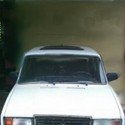
Yesterday, I talked about my work at Le Pont Gallery to a crowd of about 25 people. They didn't ask too many question but Issa said that what could I imagine - The Syrians have never been encouraged to ask questions. The frightened and orientalist Finnish Institute had said that I should not show any works containing sex or politics but Issa, my Aleppian host and the director of Le Pont, told me to talk like anywhere else and people seemed to like what they saw. When I read the Manifesto of Turbo Realism, I pointed out that it was written in the global context and should not be interpreted to be particularly against the Syrian regime. After the lecture I went with Issa to May and Nathalie’s place to see their paintings. They both graduated last year from the Faculty of Fine Arts of the Aleppo University. Then we went to have dinner and smoke nargile. After that we got a cab to go to have some drinks in the decadent Baron Hotel, where people like Agatha Christie and Lawrence of Arabia lived and partied. I was already sitting in the back seat of the taxi when men in civil clothing holding automatic guns told us to get out. Issa had taken a photo of an old Lada parked next to a building with president Assad’s photo but no text was telling it was a police station. Nobody was able to explain me what kind of security organization it was. Issa was taken into the buiding and the rest of us were left in the street but our ID cards were taken. I asked the man to identify himself. He smiled and made clear and he had a gun and he didn’t need any badge. Later Nathalie was taken inside the buiding also to be interrogated by a fat guy who had arrived in a fancy car with two bodyguards. We were set free one hour later. Issa came out with a bunch of men who forced him to say both in Arabic and English that he was sorry for taking the photo of the security car and causing problems. For Issa this seems to be normal. He is the official trouble maker of the Aleppian art world and the organizer of the controversial International Photo Festival and Women's Art Festival.
After the incident, one of my students (in the workshop beginning today) showed us a photo of that same sinister car taken with her mobile phone. I told her with admiration that it's the attitude she should have in her all art work.
FINNISH CENSORSHIP IN SYRIA
07 September 2011, Damascus
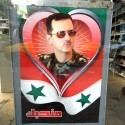
President dairy products are here popular. I asked the driver who picked me up from the airport why there are photos of president Assad everywhere. He said that it’s because everybody loves him. I’ve been taking photos of the photos of the president on the shop windows. Most of the businesses have them but also honor the father of the owner with a picture. Other hero often depicted is Real Madrid's Christiano Ronaldo. Two guys stopped me and wanted to see my photos. Police? No idea. They said my photos are very good.
The Finnish newspaper Helsingin Sanomat asks every week 120 intellectuals of the country opinion on current issues. This week the question was can the West win the War on Terrorism? I answered that they can win by nuclear bombing all Muslim countries to the stone age, carrying out an ethnic cleansing in the Western countries interning the Muslims, their supporters and other dissidents in camps. Furthermore the CIA should infiltrate agents in every company, family and square to report of any activity against the freedom, democracy, capitalism and other Western values. I read the answer to the trainee of the Institute who lives with me and she informed the director of the Institute, now in Helsinki, who sent me a message telling that if my answer will be published, the residency is canceled immediately. In my answer, I didn’t tell any opinion if the West should win. The question was technical and my answer was technical. The director says that the Syrians and Arabs don’t understand irony and sarcasm and they would burn the Institute if my comment is published in Helsinki. Does he think they are less intelligent than the Westerners? How an orientalist and a colonialist can be the director of the Finnish Institute in the Middle East?
The Institute demands the right to censor all my comments in media during and after the residency. I think they have no idea who they are dealing with. I was afraid of spying and censorship of the government's intelligence service but now I've been spied and censored by the orientalist Finnish Institute.
THE DAMASCENERY - ALL POSTCARDS FOR ME ALONE
05 September 2011, Damascus
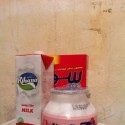
My first Damascene breakfast: Rhiana Farms milk and Nescafé. Anniina says we live in a bubble - we can just read the death toll on Al Jazeera news every morning. Should I believe in Al Jazeera, BBC and CNN that transmit only lies if you ask the supporters of the government? Or should I read the news from the Russian RT or Hezbollah’s Al-Manar?
Everything looks normal here in the Christian old town except there are no tourists at all. All postcards sold at the souvenir stalls are for me alone. Did I come to a conflict zone where I’m going to see no conflict? The only violent thing is the mosquito commando raiding my body last night. I’ve walked down the most ancient Arab street in the world. I’ve seen at the souq the funny honeymoon lingerie that the whole Arab world comes here to buy. I’ve been in Omayad Mosque and spotted the skeleton of John the Babtist but I though there was going to be corpses of the victims of the state terrorism on the streets.
|
|
|
|
|
|
| |
2020
2019
2018
2017
2016
2015
2014
2013
2012
2011
2010
2009
2008
2007
2006
|
| |

|
| |
| |